
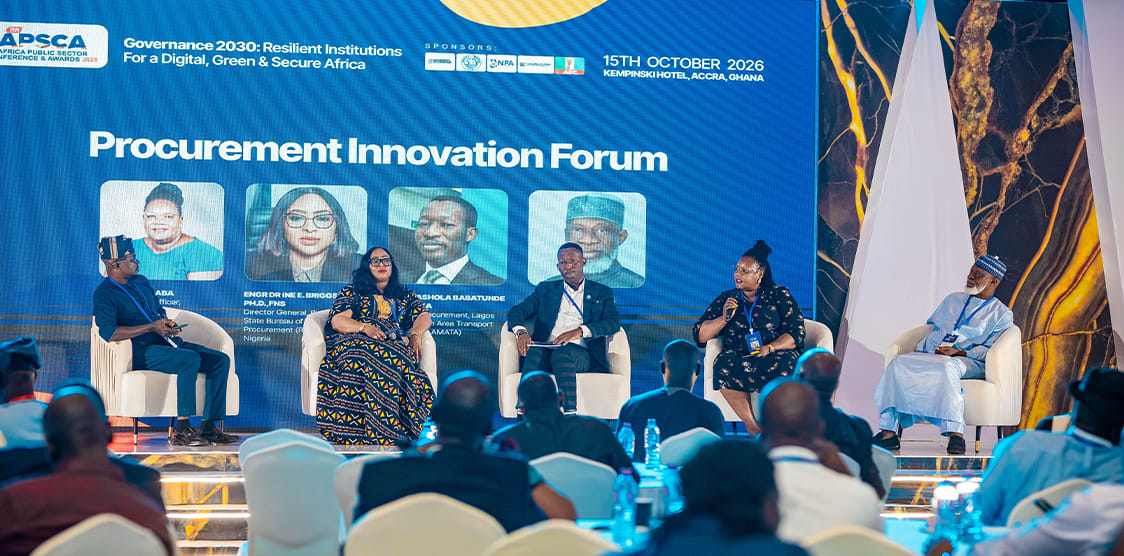
he 7th Africa Public Sector Conference and Awards in Ghana, the Procurement Innovation Forum brought together practitioners from across the continent to examine how public procurement can deliver greater transparency, efficiency and value for money.
Brenda Esilaba, Supply Chain Officer, Nuclear Power and Energy Agency (NPEA), Idris Musa Onsachi (Senior Special Assistant to the Hon. Minister of FCT on Procurement), Engr Dr Ine E. Briggs, Ph.D.,FNSE, Director General, Rivers State Bureau of Public Procurement (RSBoPP), Nigeria and Engr Fashola Babatunde Adeyinka, Head of Procurement, Lagos Metropolitan Area Transport Authority (LAMATA) discussed practical reforms needed to reduce delays, strengthen oversight and ensure that government spending produces measurable results in infrastructure and public services.
Idris Musa Onsachi, Senior Special Assistant to the Honourable Minister of the FCT on Procurement, explained how the FCT Administration has worked to cut unnecessary delays from the start of the procurement process.

“From the beginning of the process of procurement, where we have need assessment, where we have solicited for tenders, what we have done there to reduce delay is that all these eligibility requirements that we normally requested from the bidder, there was a link and that link, we usually go to the portal and cross-check from them whether those bidders are actually having the qualification requirement,” he said.
He noted that the administration now verifies documents such as tax clearance directly with the Federal Inland Revenue Service rather than requiring contractors to resubmit them. “All these ones, we have put those ones in place to ensure that procurement is done seamlessly,” Onsachi added, while also highlighting regular reporting to Nigeria’s Bureau of Public Procurement.
Brenda Esilaba pointed to the country’s electronic government procurement system as a model for standardising processes and reducing risks.

“To prevent the loss of the risks in procurement, we came up with the initiative of electronic procurement, popularly known as EGP, that has standardised all the procurement process across all the organisations in Kenya,” she said.
Esilaba explained that the platform now covers the entire cycle from planning through tendering, evaluation and award.
“We are using the platform for electronic procurement, which starts from the planning process up to the award process.
From the beginning, the tendering process, the evaluation, and all of those processes are all done in the system, which has minimised even a lot of corruption,” she stated, adding that the system helps safeguard public funds through greater coordination and equal opportunity.
Engr.Briggs, stressed that cost overruns and delays often begin long before a contract is signed. “A lot of times in public procurement, the result is not at the point where you are searching for the result, it starts from the planning stage,” she said.

Briggs emphasised the need for realistic in-house estimates, accurate bills of quantities and continuous monitoring. “It is important to monitor and evaluate contracts.
It is important to do audits to see how the projects are implemented. It is very tight monitoring and evaluation. We are able to call the procurement entities and contractors to order and to the terms of the contract awarded,” she noted.
Engr. Fashola Babatunde, highlighted the importance of involving user departments early and maintaining active oversight throughout implementation. “Right from the beginning of the activity, from the planning, of course, we look at the documents… we identify each and every activity, and then what is expected to be delivered,” he said.

He added that supervising agencies must conduct both structured and unannounced site visits.
“The supervising agency… at intervals, particularly for work related, that they do monitoring, structured monitoring, they unannounced monitor, they have the legal rights to go to the site and check,” Adeyinka explained, arguing that awareness of such oversight encourages contractors to stay aligned with agreed timelines and specifications.


