
Flour Mills’ Cephas Afebuameh Urges African Firms to Prioritize Human Capital in Supply Chains
African organisations must place human capital at the centre of procurement and supply chain transformation...
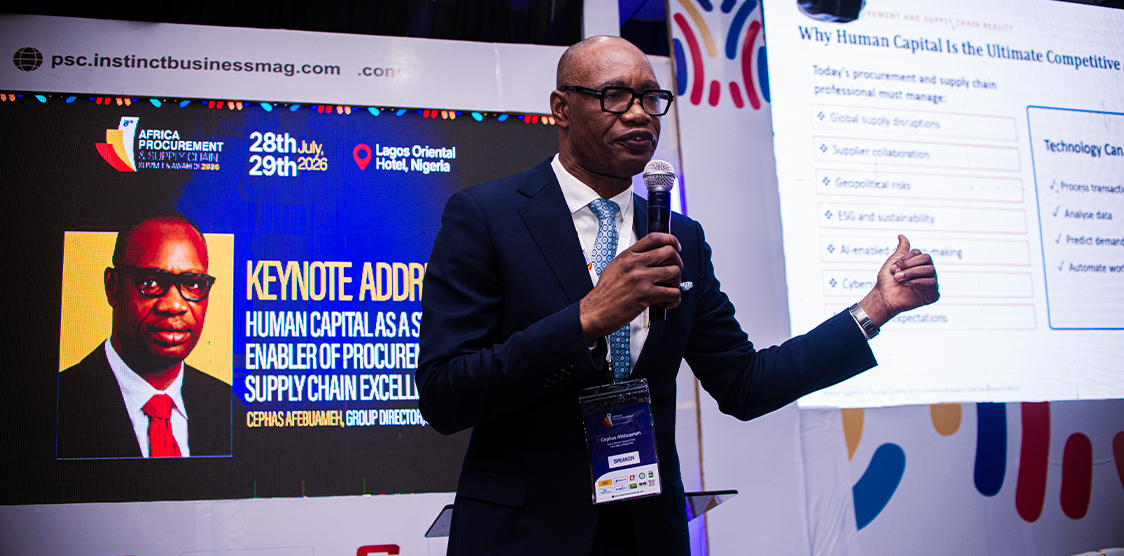
frican organisations must place human capital at the centre of procurement and supply chain transformation if they are to unlock sustainable growth, strengthen resilience and maximise investments in technology, according to Cephas Afebuameh, Group Director, Supply Chain, Flour Mills of Nigeria Plc.
Delivering a keynote presentation at the 8th Africa Procurement and Supply Chain Conference and Awards (APSCHA 2026) in Lagos, Afebuameh argued that while digital technologies, artificial intelligence (AI) and automation continue to reshape procurement globally, the true competitive advantage lies in leadership, organisational culture and people development rather than technology alone.
Speaking on the theme, "Human Capital as a Strategic Enabler of Procurement and Supply Chain Excellence in Africa," he said the continent stands on the brink of unprecedented economic transformation driven by the African Continental Free Trade Area (AfCFTA), digital procurement, manufacturing growth, infrastructure expansion, and increasing emphasis on sustainability and resilience.

Afebuameh maintained that these opportunities can only be fully realised through organisations that invest deliberately in developing capable leaders and high-performing teams.
He stressed that businesses no longer compete solely on technology, but through the quality of their workforce, the strength of their leadership, and the organisational culture they cultivate.
Technology enables performance, but human capital delivers excellence," he said, explaining that procurement excellence is achieved when talent, skills, values and innovation are supported by effective leadership and a strong organisational culture. He noted that even the most advanced supply chain technologies cannot compensate for weak leadership, while exceptional leaders can unlock the full value of every technology investment.
According to Afebuameh, today's procurement and supply chain professionals face an increasingly complex operating environment characterised by global supply chain disruptions, geopolitical uncertainty, supplier collaboration challenges, cybersecurity risks, sustainability requirements, AI-enabled decision-making and rising customer expectations. While technology can process transactions, analyse data, automate workflows and predict demand, he said only people can build trust, exercise ethical judgement, negotiate strategic partnerships, inspire innovation and make critical decisions under uncertainty.

He further described technology, people and leadership as complementary pillars of organisational success.
"Technology provides intelligence, people provide wisdom, while leadership provides direction," he told delegates, urging executives to recognise that digital transformation cannot succeed without strategic human capital investment.
Afebuameh also warned that the greatest risk facing supply chains is no longer technology failure but leadership failure.
He said organisations with ineffective leadership often struggle with procurement fraud, weak governance, deteriorating supplier relationships, employee disengagement, resistance to change, high staff turnover and unsuccessful digital transformation programmes. By contrast, effective leaders shape organisational culture, strengthen accountability, encourage innovation, uphold ethical standards, foster collaboration and build long-term resilience.
To illustrate the relationship between people and technology, the Flour Mills executive introduced what he described as an "Executive Formula" for procurement excellence: People × Leadership × Culture × Technology = Excellence.

He explained that organisational success is based on multiplication rather than addition, noting that when leadership is weak, every investment in technology produces diminished returns regardless of the sophistication of digital systems.
Afebuameh outlined five strategic priorities organisations should adopt to build sustainable procurement and supply chain excellence. These include recruiting employees based not only on technical competence but also integrity, adaptability and learning agility; developing future leaders across all organisational levels; creating a culture of continuous learning; aligning human resource strategies with procurement objectives; and rewarding collaboration and innovation by breaking down organisational silos.
He added that every investment in technology should be matched by a corresponding investment in people capable of extracting maximum value from those technologies.
The supply chain leader also challenged executives to evaluate whether their organisations are investing in people with the same urgency as they invest in digital systems. He urged business leaders to assess whether leadership is being developed across all levels, whether HR and procurement functions operate as strategic partners, whether organisational culture can outlive technology platforms, and what leadership legacy today's executives intend to leave behind.
Concluding his presentation, Afebuameh said artificial intelligence will continue transforming procurement operations but insisted that long-term success will always depend on human intelligence and purposeful leadership.
He emphasised that while machines can automate processes, only people can create purpose, only leaders can inspire performance, and only organisations that consistently invest in human capital will sustain procurement and supply chain excellence in an increasingly competitive business environment.


